Skip to content

Librevet for manufacturers

Be in the plan, not just in the catalogue

Surgeons choose the implant while they plan the surgery, days before anybody rings a rep. Librevet puts your templates in that moment — at true scale, on the surgeon's own radiograph.

The implant is chosen before theatre

A surgeon planning a TPLO decides the plate, the size and the screw pattern at the planning stage — sitting at a screen, days ahead, weighing what fits. By the time anyone opens a box, the decision is old.

Librevet is where that decision happens. Being in the library means being one of the options on the radiograph at the moment it is made, at the right size, next to everybody else's.

And the plan is not a side tool. Where a hospital runs ezyVet, Librevet reads the patient straight from the practice record and files the finished plan back onto it — so your template ends up in the document that sits in the patient file.
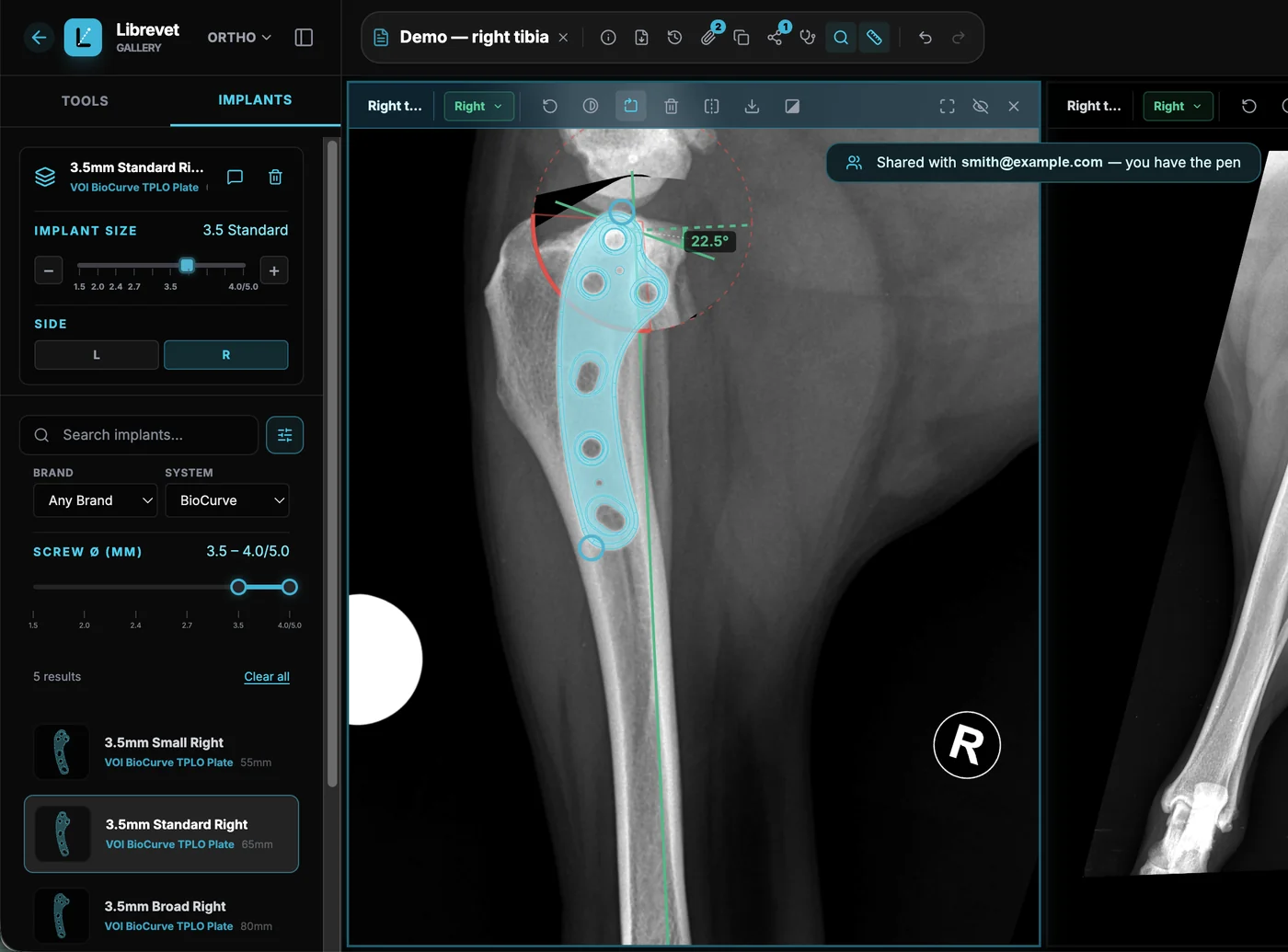
Librevet Ortho 2D with the implant panel open: a size range and side selector, brand and system filters, and three VOI BioCurve TPLO plates listed at 55, 65 and 80 mm — with the selected plate overlaid at true scale on a right tibia beside a tibial plateau angle of 22.5 degrees.
The surgeon picks the size against the bone, not from a page.

What you get

A portal of your own, run by your people, on your schedule.

Your library, managed by your people

Your reps get their own portal, scoped to your brand and nobody else's. They draft a template, submit it, and it goes live once we have checked it against the specifications you supplied. No tickets, no waiting on us to type it in for you.

  • Draft, submit, revise, and pull a submission back before it publishes
  • Bulk-load a range from a spreadsheet or a ZIP of drawings
  • Every change reviewed before it reaches a surgeon

Control who sees what, and when

Not every plate should be visible to every surgeon on day one. Templates can be public, restricted to named vets, scheduled to appear on a launch date, or opened to a beta group first and to everyone later.

  • Restrict a template to named clinics or a trial group
  • Schedule a release so it appears the morning of the launch
  • Open a beta template to everybody on a date you set

Sponsor your customers

Buy a pool of licence seats and let your reps hand them out to the clinics they look after. The vet signs in and finds your library waiting for them — a reason to keep the relationship, delivered through the tool they already use to plan.

  • Assign seats in bulk, by email address
  • A seat waits for a vet who has not signed up yet
  • Unassigned seats stay in your pool until you use them

See what actually gets planned

Which of your implants surgeons place on a plan, and how that moves month to month. To be exact about what this is: it counts template placements made during planning, not confirmed purchases and not implantations. It is still a number you cannot get from a sales report, and it arrives earlier.

  • Template placements per template, per month
  • How many distinct surgeons, not just how many clicks
  • Nothing below five distinct surgeons is ever shown

Inside the portal

Not a mock-up — this is the portal, with a demo brand's library in it.

The manufacturer portal's live template list, showing templates marked public, restricted, scheduled for a release date and open as a beta.

Your library, your states

Public, restricted to named clinics, scheduled for a launch date, or open to a beta group first — all of it set by your own reps.

The usage screen: a table of templates by month with placement counts and surgeon counts shown as five-or-more, above a note explaining the privacy floor.

What actually gets planned

Placements per template per month, and how many distinct surgeons. Nothing appears until at least five of them have used it.

The client licences screen: a seats-used meter, a list of licensed client vets marked active or pending sign-in, and a brand inbox showing two messages from a surgeon.

Seats you hand out

Buy a pool, assign seats by email — a seat waits for a vet who has not signed up yet. Underneath, your brand inbox: a message a surgeon sends you lands here and in your email. The surgeon-side send is in build now.

What you will never see

Surgeons will only put real cases into a tool that does not sell them out. The limits below are what make the usage data acceptable to them — and therefore what makes it exist at all.

Anonymised, and enforced rather than promised

Usage is aggregated into monthly buckets per template. A bucket touched by fewer than five distinct surgeons is not returned at all — that floor lives in the database's own access rules, not in a report we generate, so it holds whoever is asking.

No patients, ever

No animal, no owner, no clinical detail and no case ever reaches a manufacturer. What a surgeon chooses to share with a colleague or send to a specialist stays inside Librevet and is invisible to you. A manufacturer sees monthly counts of their own templates, and nothing else.

Your brand only

A rep is scoped to the brands they represent. They cannot see another manufacturer's templates, drafts, usage or licences — and neither can anyone else see yours.

Manufacturer-neutral by design

The library is built to carry any manufacturer's templates, and the planner does not steer a surgeon towards one brand over another. That is a design decision rather than a marketing one: it is why a surgeon trusts what the planner shows them, and a planner nobody trusts is not worth being in.

What it means for you is that your implants are judged on fit against the radiograph in front of the surgeon, which is the comparison you would want anyway.

Common questions

What do you need from us to get started?

Dimensioned drawings or CAD for the implants you want templated, and a name for whoever will run the portal. We build the first set with you so the geometry is right, and after that your reps maintain it themselves.

Are the templates accurate enough to plan from?

They are drawn to true millimetre dimensions and overlaid on a calibrated radiograph, so a 3.5 mm plate is drawn at 3.5 mm against the scale the surgeon set. Accuracy follows that calibration, which is why calibration is per-image — magnification varies between exposures — and why the app refuses to place a template until a scale has been set. The plan is decision support; the surgeon verifies it.

Is Librevet exclusive to one manufacturer?

No brand is bought into a default position, and the library is built to carry any manufacturer's templates — a surgeon plans with the implant they have chosen, and a planner that only knows one brand is a catalogue rather than a tool. The library itself is still early, which is the honest answer to why you should talk to us now rather than later: there is room to get your systems in properly rather than appended to somebody else's. If you are weighing a closer arrangement than a place in the library, that is a conversation to have with us directly.

What does it cost a manufacturer?

Talk to us. It depends on the size of the library, whether you want to sponsor licences for your customers, and what you want out of the usage side.

Can we reach surgeons through it?

Not on your initiative, and that is deliberate. There is no surgeon directory, no broadcast, and no way for a rep to open a conversation with a surgeon who has not written to them first. Surgeons put real cases into Librevet because it does not treat them as an audience, and that is worth protecting. Surgeon-initiated contact — where your customer writes to you and you answer — is being built now, under that same rule.

Let's get your library in

Send us what you have — a catalogue, dimensioned drawings, CAD, or just a list of systems — to support@librevet.com, and we will come back with what building your library looks like: scope, timeline and cost.

Email support@librevet.com